
The Last Frontier
On the erasure of attention in an age of constant capture

Conquest used to be geographic. Power was measured in acreage and borders—how many people you could uproot or how many maps you could redraw. For centuries, empires expanded outward: seizing land, minerals, bodies, and entire cultures. Colonialism was an economic project disguised as destiny. Europe treated the world as inventory: gold in the Caribbean, rubber in the Congo, people from West Africa, wheat in India.
But conquest adapts. Once coastlines were occupied and borders set, once every navigable route had been charted, the old model of expansion reached saturation. There was no “new world” left to claim. Yet the force driving colonial expansion didn’t disappear; it changed shape. It shifted from the external world to the human body.
Throughout the eighteenth and nineteenth centuries, the frontier shifted from territory to labor. What had once been justified through the language of discovery was now justified through the language of productivity. The plantation became the blueprint for industrial capitalism, and the factory became its engine—regimented shifts, mechanized lines, days sliced into punchcards. Rather than exploiting land directly, empires and emerging states learned to convert human time into profit.
Factories reorganized life into measurable units. The clock replaced the compass. Instead of mapping new coasts, states mapped the human body into hours: the shift, the workweek, the clock-in system. Time itself became measurable, ownable. Discipline became the new technology of control. The colonial mindset simply found a different substrate.
But even that form of extraction had limits—there are only so many bodies, only so many hours one can work.
So the frontier shifted again.
The twentieth century introduced a new, quieter form of capture: datafication. What began as bureaucratic record-keeping and early computing infrastructure evolved into something far more expansive. By the late twentieth century, states and corporations had begun to realize that human behavior—what you like, where you move, what you search, and who you speak to—was itself a valuable economic resource. Every action online generated a residue: a trail of preferences and patterns that could be captured, processed, and predicted.
Datafication began as a simple question of storage: how much information could be archived, processed, or indexed. But once that infrastructure existed, it created possibilities beyond its original purpose.
After 9/11, those possibilities were seized. The Patriot Act fast-tracked forms of data collection and digital surveillance that would have been politically unthinkable just years prior. What the state framed as security quickly produced a new technological norm: mass data retention, metadata tracking, and algorithmic triage. And as soon as these systems were built, corporations realized they could be repurposed for something else entirely. The logic of state surveillance became the template for corporate extraction.
By the 2010s, this system matured into what Shoshana Zuboff calls “surveillance capitalism.” It was marketed as convenience, efficiency, and personalization. In practice, it was a new kind of gold rush. Companies didn’t need your land or your labor anymore. They needed your behavioral surplus—the unmonetized bits of yourself you left behind without noticing. Every click was a tiny disclosure; every pause, a small confession.
But even this mode of capture had limits. There is only so much behavior you can capture passively. The real breakthrough came when companies realized that data wasn’t just something you could collect—it was something you could engineer. To predict behavior more accurately, they needed to influence it. To influence it, they needed to shape what you paid attention to. And to shape your attention, they needed to occupy the mental space where decisions form.
They needed your attention.
The jump from data to attention wasn’t a natural evolution. It was a break. Once companies realized that raw behavioral data could only take them so far, they stopped treating users as sources of information and began treating them as sites of influence. Algorithms learned to identify the emotional and cognitive states that made people most manipulable—boredom, loneliness, late-night restlessness, and the quick dopamine hit of novelty. Platforms didn’t just want to collect these states; they wanted to generate them.
Infinite scroll, autoplay, push notifications, the curated “For You” feed—these were not UX flourishes. They were behavioral technologies, exploiting cognitive vulnerabilities: the compulsion to complete patterns, the social need for validation, the fear of missing out, the neurological pull of variable rewards. Data collection evolved into behavioral steering and then into behavioral dependency.
Here, the frontier fully shifted from information to attention. Data reveals who you are; attention gives companies control over who you might become. The goal was no longer to capture your behavior after the fact, but to choreograph it in real time. The more time you spent on a platform, the more predictable you became, and the more predictable you became, the more profitable you are.
In this system, attention isn’t something you give. It’s something pried loose. Platforms learned that the most predatory design is the one that collapses the boundary between desire and reflex, where opening an app stops being a choice and becomes an automatic gesture. Sometimes I notice my own hand doing this before my mind catches up. I’ll unlock my phone without remembering why, swipe to the same three apps, and only then realize I wasn’t trying to do anything—I was just answering a reflex my body had learned.
The result is a mode of capture more intimate than anything that preceded it. Land could be seized. Labor could be disciplined. Data could be tracked. But attention is different. It sits at the root of consciousness—the raw material of perception, decision, and imagination. To colonize attention is to intervene in how a self forms in time.
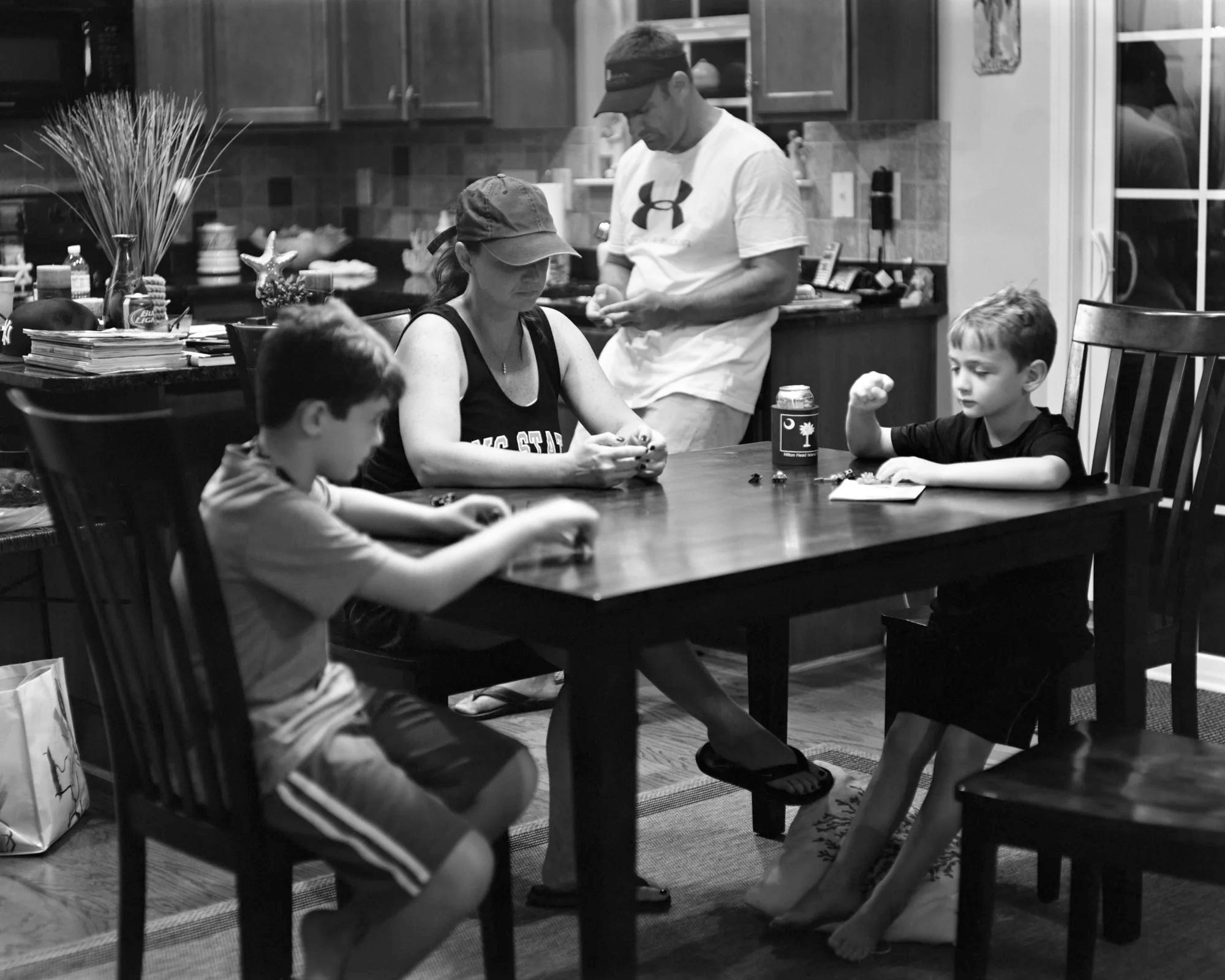
An image from Eric Pickersgill’s Removed series
This is why modern extraction feels totalizing. The conquest no longer happens on land or in factories anymore; it happens in the places where your thoughts take shape. The factory floor has moved into the mind, but what’s being reorganized is your inner life. What’s being extracted isn’t labor or data—it’s the capacity to direct your own attention, the very basis of autonomy.
I realized this shift one afternoon in a moment that should have been forgettable. I was sitting on a low stone wall outside my dorm, doom scrolling Instagram so quickly the images blurred into one long smear of color. The air had that late-autumn chill, but I didn’t feel it. When I finally looked up, the sky had shifted from blue to that dimming gold without my noticing. A whole piece of the day had passed, and I had no memory of how I’d spent it. I couldn’t recall the last ten posts I’d seen. I couldn’t recall opening the app.
That missing sliver of consciousness—that gap—is what extraction looks like now.
The danger of cognitive capture is not just that it consumes your time; it reshapes the texture of your attention, the pace of your thoughts, the inner rhythms that make concentration or presence possible. A mind constantly interrupted doesn’t just lose minutes; it loses the capacity for sustained interiority. Studies show that the average uninterrupted attention span online has dropped from roughly 150 seconds to about 47, a decline of more than two-thirds. Over time, your thoughts begin to fracture into the same units the system profits from.
A colonized mind is, first, a distracted mind. Distraction feels harmless—just a few seconds lost—but it compounds. Thoughts splinter into shorter bursts. Your hand moves toward your phone before you register the impulse. It becomes harder to stay with a book, a conversation, or even a feeling without wanting to escape into the scroll. When I watch movies with friends, I ask them to put their phones away for the full two hours. For some, it feels impossible.
The economy of attention thrives on people who cannot sit with complexity, who grow uneasy without stimulation, who accept the rapid tempo of desire as inevitable. When your attention is fragmented, you feel compelled to fill the gaps. When you feel compelled, you click. When you click, you generate data. And when you generate data, the system becomes even better at capturing you. It is a cycle that sustains itself by narrowing the range of what your mind can comfortably hold.
In a world where almost everything feels monetizable, nature remains one of the few realms that resists this logic—not because it is pure or idyllic but because it is structurally incompatible with extraction. A tree does not care how long you look at it. A river does not adjust its pace to keep you entertained. A forest does not interrupt itself every fifteen seconds to recapture your drifting focus. Nature has no algorithm refining your desires and no profit motive woven into its rhythms.
What the natural world offers is not escape but a different temporal architecture. It moves on slow time—cyclical, indifferent, ancient. When you watch clouds shift, nothing is being sold back to you. When you walk through the woods, there is no invisible hand selecting which leaf should fall along your path. In nature, events unfold without reference to you. That indifference is freeing.
Nature is not a refuge because it’s peaceful. It is a refuge because it is unextractable at the cognitive level. It returns your mind to you undivided. It restores boredom, which is really just space. It gives back continuity, which is really just freedom. In a world designed to fracture your attention, the natural world is one of the last places where your thoughts unfold at their own pace rather than at the pace dictated by an algorithm.
This is why tech companies have even flooded platforms with “nature content”—endless videos of sunsets, forests, waves—each one shaved into consumable fragments. The real thing threatens the system not because it is beautiful, but because it is uncommodifiable. The natural world offers a model of existence that cannot be optimized, accelerated, or turned into engagement. It interrupts the economic logic that governs so much of modern life.
The land was taken. Labor was taken. Data was taken. Now the frontier is the mind.
Which means the last freedom we have lies in how we choose to give our attention—and to whom. If extraction today operates internally, then resistance must, at least in part, operate there as well.
Nature offers a similar kind of return. It is not the antidote to technology, nor is it a completely pure space untouched by modern humans. It is something more subtle and more necessary: a reminder that not everything exists to extract value from you. It offers a counter-logic rooted in being a human instead of speed, presence instead of profit, life instead of accumulation.
I only started to understand this once I began meditating every morning. For five minutes, I sit with nothing—no notifications, no feeds, no stimulus—and it feels like reacquainting myself with a version of my mind I had forgotten. The quiet doesn’t fix anything. But it reminds me what it feels like to have an attention that isn’t being pulled, prodded, or optimized—tiny acts of resistance against a world that would prefer my mind fragmented.
They don’t save me, but they help me remember what it feels like to inhabit my own attention. Maybe that’s the truest form of freedom left: choosing, even briefly, to be present in a world that profits when you are not.
What worries me most isn’t just what’s being taken from us—it’s what we stop being able to understand on our own. A society that can’t hold its attention can’t hold memory, conviction, or even a shared sense of what’s real. The battle over attention is not just a personal one. It decides what kind of selves we can become, and what kind of public we can sustain. If the mind is the new frontier, then the real stakes of distraction are not productivity or wellness but the future of human agency itself.
If attention is the last territory to defend, then deciding what gets to claim it is the closest thing we have to freedom.
**This article was published by the Harvard Independent on 12.4.25**
"Every pause, a small confession."
Indeed, very fire. I fw this a lot Luke